
City of Toronto Sign Permit Guide: Everything Business Owners Need to Know
Planning to install a new storefront sign in Toronto? Here’s what you should know about sign permits, application requirements, costs, and approvals before starting your project.
A well-designed business sign does more than display your company name. It helps customers find your location, builds brand recognition, and gives your storefront a professional appearance.
But before installing a new outdoor sign in Toronto, there’s one important thing to consider: Do you need a sign permit from the City of Toronto?
Many business owners don’t realize that installing or replacing a commercial sign may require City approval. Even if you’re simply changing the name on an existing storefront sign, you may need to check the applicable regulations before proceeding.
At Next Level Sign and Print Inc., we work with business owners across Toronto and the Greater Toronto Area to plan, design, manufacture, and install commercial signage. We also help customers understand sign permit requirements and prepare the information needed for their applications.
In this guide, we’ll explain how Toronto’s sign permit process works, what documents you may need, and how to prepare your signage project to avoid unnecessary delays.
1. Do You Need a Sign Permit in Toronto?
In many cases, yes.
The City of Toronto regulates commercial signage under Toronto Municipal Code Chapter 694, Signs, General. These regulations help control the size, location, appearance, and installation of signs throughout the city.
Depending on the type of sign and property, you may need a permit for:
- Storefront signs: Business name signs installed above entrances or along storefronts.
- Channel letter signs: Individual three-dimensional letters, including illuminated channel letters.
- Fascia signs: Signs attached directly to the exterior wall of a commercial building.
- Illuminated signs: Exterior signs with internal or external lighting.
- Projecting signs: Signs that extend outward from a building.
- Pylon and ground signs: Freestanding signs commonly used at plazas, shopping centres, and commercial properties.
- Replacement signs: Existing signs being replaced, relocated, or significantly modified.
Not every sign requires a permit. Certain signs may qualify for exemptions, depending on their type, size, and location.
For example, some indoor signs and certain small signs may not require a sign permit under Chapter 694. However, additional rules can apply depending on the property and installation.
Our advice: Before spending money on manufacturing a new sign, confirm whether your proposed design meets the City’s requirements.
2. Why Does the City of Toronto Require Sign Permits?
Sign permits are intended to ensure that commercial signage follows the City’s regulations.
These rules address several important considerations, including:
- The overall size and placement of signs
- The number of signs permitted on a property
- Sign illumination and brightness
- Compatibility with the surrounding area
- Public safety and structural considerations
- Restrictions in certain sign districts
Toronto is divided into different sign districts, and the rules can vary based on the location of your business.
For example, a sign permitted at one commercial plaza may not automatically be permitted at another property.
This is why checking your property’s specific requirements is an important first step.
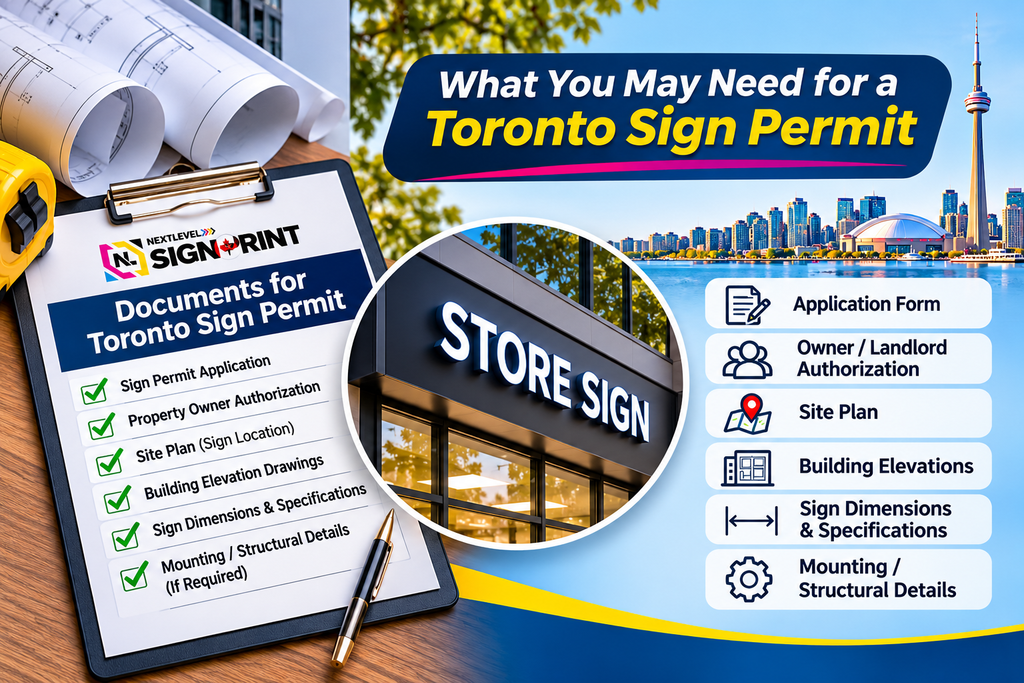
3. What Documents Do You Need for a Toronto Sign Permit?
One of the most common reasons sign permit applications experience delays is missing or incomplete information.
The exact documentation depends on your sign type, location, and installation method.
Generally, you may need the following:
Property Information
The City needs to identify the property where the sign will be installed. This includes the business address and relevant property details.
Property Owner or Landlord Authorization
If you’re leasing a commercial unit, you may need written authorization from the property owner or landlord.
Many shopping plazas and commercial buildings also have their own signage guidelines.
It’s a good idea to obtain landlord approval before finalizing your sign design.
Sign Drawings and Measurements
Drawings help the City understand exactly what you’re planning to install.
Depending on the project, these may include:
- Overall sign width and height
- Sign area and projection from the building
- Position of the sign on the storefront
- Building elevation drawings
- Sign materials and construction details
- Illumination details, if applicable
Site Plan or Location Information
A site plan may be required to show where the building and proposed sign are located on the property.
Mounting and Structural Details
Larger or more complex signs may require additional installation details or structural documentation.
Some projects may require drawings prepared or reviewed by a qualified professional.
How we help: At Next Level Sign and Print Inc., we can take storefront measurements, review the proposed sign location, and help coordinate the drawings and sign specifications needed for your project.
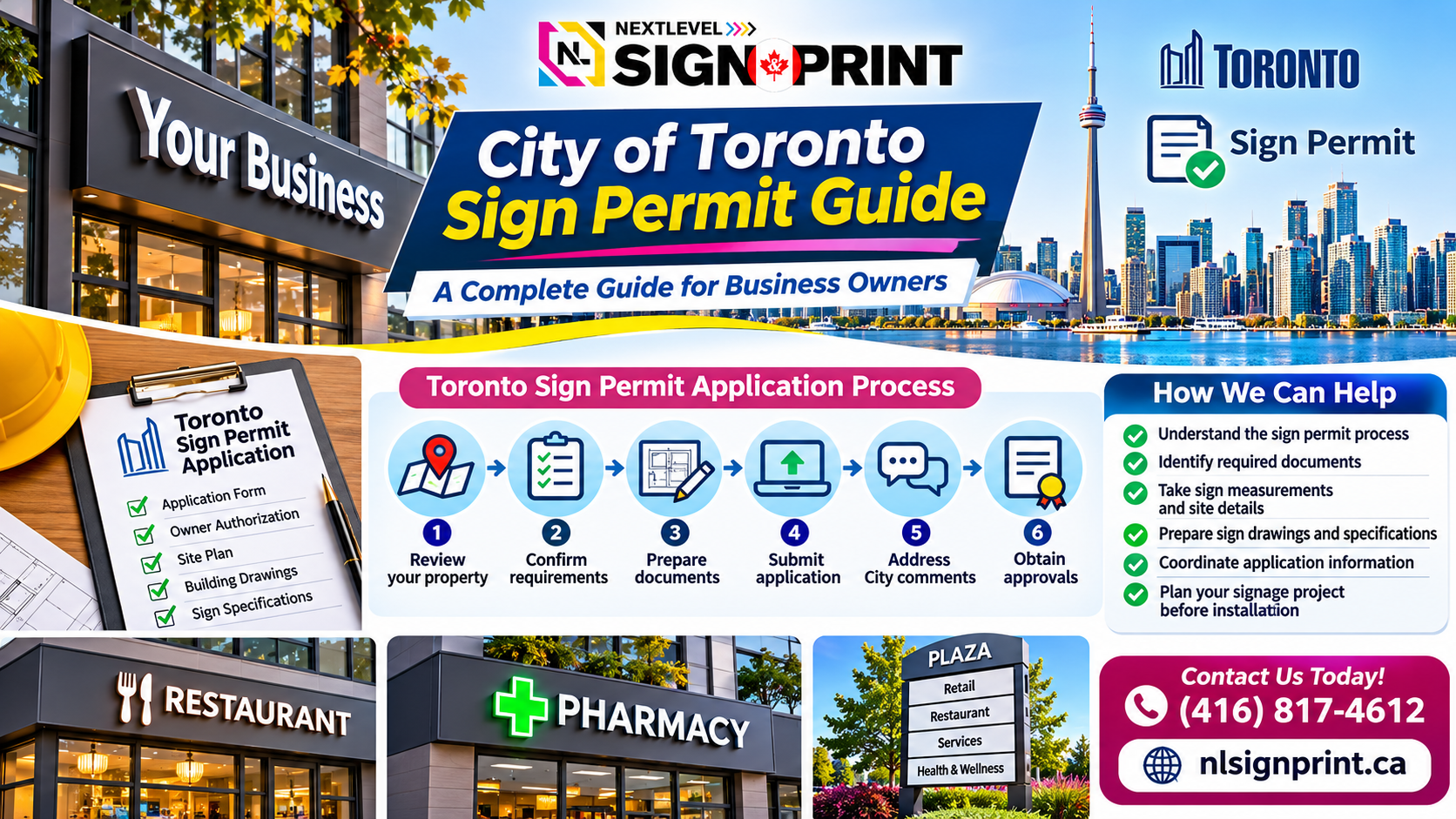
4. How to Apply for a Sign Permit in Toronto
The application process may seem complicated at first, especially if you’re opening your first business.
Here’s how it generally works.
Step 1: Check your business location
Start by identifying the property address and applicable sign district. This helps determine which regulations apply to your proposed signage.
Step 2: Decide on the sign type and size
Whether you’re planning illuminated channel letters, a lightbox sign, or a non-illuminated storefront sign, the proposed dimensions and placement must be reviewed against the applicable rules.
Step 3: Get landlord approval
If you’re a tenant, discuss the signage with your landlord or property management company. Obtain any required written authorization.
Step 4: Prepare your drawings
Gather the sign design, dimensions, building elevation, mounting details, and other required documents.
Step 5: Submit your application
Submit the application through the City’s current sign permit process, along with the required documents and fees.
Step 6: Respond to City comments
During the review, the City may request additional information, clarification, or changes to the proposed sign.
Step 7: Receive approval before installation
Once the required permits and approvals have been issued, your signage project can proceed in accordance with those approvals.
Approval timelines vary. More complicated projects may take longer, particularly when additional reviews or variances are involved.
For official instructions, visit the City of Toronto Sign Permits and Information page.
5. How Much Does a Sign Permit Cost in Toronto?
This is one of the first questions business owners ask us.
The cost of a Toronto sign permit depends on several factors, including the sign type, sign area, and applicable municipal fee schedule.
Your overall project may also involve additional expenses, such as:
- Sign drawings and design preparation
- Structural engineering, if required
- Sign variance applications, where applicable
- Additional building or electrical approvals
- Sign manufacturing and installation
Because every project is different, it’s difficult to provide one fixed permit price that applies to all commercial signs.
The City updates its fees periodically, so it’s important to confirm the current rates before submitting an application.
You can review the official City of Toronto Sign-Related Fees page.
At Next Level Sign and Print Inc., we can review your proposed sign and help you understand the information needed to plan your project.
6. Can You Replace an Existing Storefront Sign Without a Permit?
Not necessarily.
A common misunderstanding is that an existing sign location automatically allows a business to install any replacement sign.
For example, imagine you’re opening a new restaurant in a commercial plaza. The previous tenant had an illuminated storefront sign, and you want to replace it with your restaurant’s name.
Even though the building already has a sign, the replacement may still require a new permit or other review.
The requirements can depend on whether you’re changing the sign structure, dimensions, illumination, location, or other regulated features.
Before removing or replacing an existing sign, confirm what approvals are required.
This can help prevent unexpected changes after manufacturing has already started.
7. What Happens if You Install a Sign Without the Required Permit?
Installing a regulated sign without the necessary approval can create problems for your business.
Depending on the circumstances, the City may require you to address the non-compliance, apply for the appropriate approvals, modify the installation, or remove the sign.
Enforcement action and penalties may also apply.
For business owners, this can mean additional costs, lost time, and disruption to a store opening or renovation.
The better approach is to check the requirements before manufacturing and installation.
8. What if Your Sign Doesn’t Meet Toronto’s Sign By-law?
Sometimes a business wants a sign that exceeds the dimensions or placement rules permitted at its location.
For example, you might want a larger sign for better visibility, or your storefront layout may make a standard sign difficult to install.
Depending on the circumstances, you may be able to apply for a sign variance.
A variance is a request for permission to depart from specific requirements of the Sign By-law.
However, submitting a variance application does not guarantee approval. The City reviews the request based on the applicable regulations and circumstances.
In some cases, modifying the sign design may be a simpler and more practical solution.
9. How Next Level Sign and Print Inc. Can Help
When you’re opening or renovating a business, you already have plenty to manage. Signage should be one part of the project you can plan with confidence.
At Next Level Sign and Print Inc., we help Toronto and GTA businesses with commercial signage projects, from the initial design through manufacturing and installation.
Our services include:
- Storefront sign planning: Helping you select a suitable sign style, size, and location.
- Site measurements: Measuring the available sign area and reviewing the proposed installation location.
- Sign design and drawings: Preparing sign layouts and coordinating required technical information.
- Sign permit assistance: Helping organize application information and supporting documentation.
- Custom sign manufacturing: Producing channel letters, illuminated signs, lightboxes, fascia signs, and other commercial signage.
- Professional sign installation: Installing signs in accordance with the applicable project requirements and approvals.
We understand that every storefront is different. Our goal is to help you choose signage that looks professional, fits your business, and can be reviewed against the applicable regulations before production begins.
Permit decisions are made by the City of Toronto, and additional professional services may be required for certain projects.
10. Frequently Asked Questions About Toronto Sign Permits
Do I need a permit for illuminated channel letters in Toronto?
Illuminated exterior channel letter signs commonly require a sign permit. Additional electrical or other approvals may apply depending on the installation.
Does my landlord need to approve my storefront sign?
If you lease your commercial space, landlord authorization may be required for the application. Your lease or plaza signage guidelines may also require approval.
How long does it take to get a Toronto sign permit?
Processing time depends on the type of sign, completeness of the application, and whether additional reviews are needed. It’s best to begin the permit process early, particularly if you have a scheduled store opening.
Can Next Level Sign and Print Inc. help with sign permit drawings?
Yes. We can help prepare sign layouts, measurements, and project specifications, and coordinate additional documentation where required.
Do indoor business signs need a permit?
Many ordinary indoor business signs do not require a sign permit under Toronto’s general sign regulations. However, other requirements may apply depending on the type of installation, location, and building.
Can I install my sign while waiting for permit approval?
If your sign requires a permit, you should wait until the required approval has been issued before installation.
Need Help With a City of Toronto Sign Permit?
Whether you’re opening a new store, replacing an old sign, or upgrading to illuminated channel letters, planning your signage properly can save time and avoid unnecessary complications.
Next Level Sign and Print Inc. can help you review your signage requirements, organize project information, and prepare for the permit application process.
We also provide custom sign design, manufacturing, and installation services for businesses throughout Toronto and the Greater Toronto Area.
Contact Next Level Sign and Print Inc.
Address: 4140 Steeles Avenue West, Unit 4, Woodbridge, ON
Phone: (416) 817-4612
Website: https://nlsignprint.ca/
Planning a new business sign? Contact us today to discuss your project and get help with your Toronto sign permit requirements.
Disclaimer: This article is intended for general informational purposes. Sign permit requirements, fees, exemptions, and application procedures may change. The City of Toronto is responsible for determining permit requirements and issuing approvals. Always confirm the current rules for your specific property and signage project..


 Printing Products